Following an article that I recently published about the writer Barry Purcell’s advocacy for transgender ideology, he has now insisted that those who disagree with him must “do the research”. That being the case, I suppose I should look at the research.
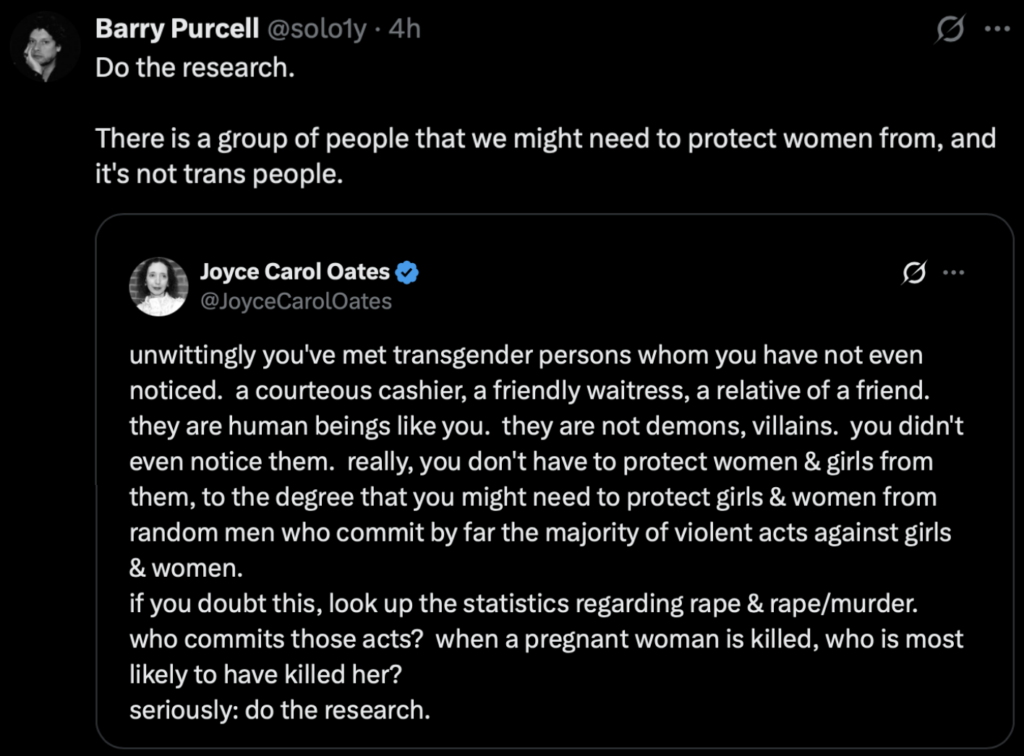
The article that I originally published responded to the position of Barry Purcell insisting that “sex is a spectrum” rather than a binary. Moreover, Barry Purcell also advocated for the position that people can change their sex by moving along this supposed spectrum from one side to the other. In response I made the following points:
- Sex across all mammals has been defined based on gametes for more than a century. A male has anatomy that is organised to produce small motile gametes, while a female has anatomy that is organised to produce larger and more nutrient-rich gametes.
- Sex is a binary because there are only two gametes. There is no third gamete. There are no intermediate gametes. There are no people who produce both gametes. Mammals cannot change their sex because there is no mammal that has ever changed the gamete that their anatomy is organised to produce.
- This definition of sex has huge explanatory power for evolutionary biologists. There are much greater requirements on females than males associated with reproductive success from each of their gametes, and many behaviours across all mammals arise from this fact. Female mammals tend to be more selective in their choice of mates, whereas males are more aggressive and promiscuous.
- Humans are not immune from the sex-based behavioural implications that arise from the differences between the gametes. For example, more than 90% of violent sexual crimes are committed by males.
This raises very obvious safety issues for women and girls, which society has responded to in part by creating rights to female-only spaces. Especially where females are most vulnerable (for example, when they need to undress or when they are incarcerated) males are excluded from those spaces. In contrast, Barry Purcell argues that rather than biological sex being the determining issue, trans identification is a pertinent factor in this regard:
“There is a group of people that we might need to protect women from, and it’s not trans people.”
It seems from the Barry Purcell tweets illustrated above that there is agreement on the need to protect women and girls from males in certain circumstances. However, advocates for transgender ideology insist that “trans women are women”, and on this basis demand that trans identified males must be permitted in female spaces. The question we need to research then is whether in general terms, men who identify as a women also demonstrate the much lower female-pattern of offending, or if that cohort can be seen to commit the much higher male-pattern rate of offences. That is, if we can agree that the data show males committing vastly more violent sexual offences than females, we should be also able to determine if trans identified males offend at rates that are consistent with other males, or at rates consistent with females.
There has been detailed evidence submitted to the Women and Equalities Select Committee of the UK Parliament on this topic. That evidence reports as follows:
- 3.3% of women incarcerated in the UK are sex offenders
- 16.8% of men incarcerated in the UK are sex offenders
- 58.9% of trans identified men incarcerated in the UK are sex offenders
This does not suggest that trans identified men demonstrate the much lower female-pattern of sex offences, instead of the much higher male-pattern of such offences. It strongly implies the precise opposite. Moreover, the same pattern is evident in other countries. The Canadian Correctional Service uses the term ‘gender diverse’ to include both trans identified people, as well as gender fluid and non binary identified people. They reported as follows:
- 30% of all men in custody had committed sex offences
- 6% of all women in custody had committed sex offences
- from the gender diverse offenders identified, 37% had histories of committing sex offences
- 86% of the gender diverse offenders who had histories of committing sex offences, were trans identified males
- 0% of the gender diverse offenders who had histories of committing sex offences, were trans identified females
- 14% of the gender diverse offenders who had histories of committing sex offences, were in other categories such as gender fluid and non binary identified people
Again, it appears the cohort that women and girls need protection from is natal biological males. As evolutionary biology has long told us, the binary gametic definition of sex explains why male mammals are more violent than females. The research also shows that biological sex is the explanatory factor in this area, and a human male who identifies as transgender is still a male because mammals cannot change their sex. This was perhaps most clearly stated by a longitudinal peer-reviewed study in Sweden, which concluded as follows:
“In this study, male-to-female individuals had a higher risk for criminal convictions compared to female controls but not compared to male controls. This suggests that the sex reassignment procedure neither increased nor decreased the risk for criminal offending in male-to-females.”
That is, males who identify as transgender are still male and therefore retain a male-pattern of offending, even after their transition.
Barry Purcell recognises that males are much more likely to commit violent sexual offences and as such, he accepts it is right and proper that women and girls are entitled to female-only spaces. However, when a man claims to have changed their sex and complains about the upset it causes them when they are excluded from female spaces, Barry Purcell privileges the feelings of that man over the safety of women and girls. This is the ideology that considers a male rapist who describes their ‘rapid onset post conviction gender dysphoria’ and insists that they must be locked in a cell with a woman.
Admonishing others to “do the research” is not a defence of this position. It is an empty mantra that seeks to deflect from the appalling harms caused by the ideology being promoted.